The Access Test: Why Finding Help Is Not the Same as Receiving Care
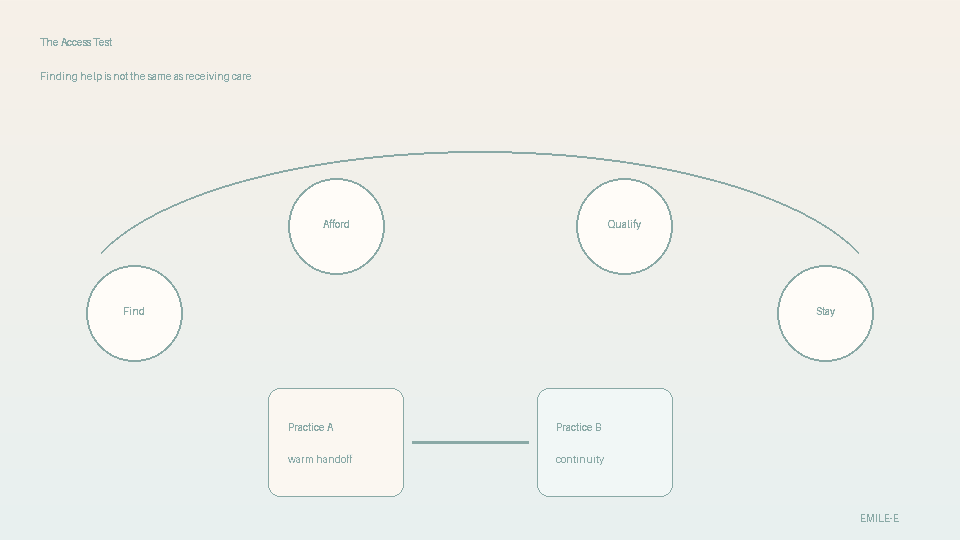
Directories answer the first question. Care requires four. The Access Test is how practices know whether a referral becomes a relationship, or just another abandoned search.

Someone finally asks for help.
They search. They scroll. They find a name, a directory listing, a "we accept new clients" page. Relief shows up for a moment. Then the real work starts, and it is quieter than discovery ever was.
Can they afford the work? Do they qualify for the clinician, the payer, the schedule? If the first door is not the right door, does anyone walk them to the next one, or do they start the search over from zero?
That gap between finding help and receiving care is where too many people disappear. Not because clinicians do not care. Because the system between practices is still mostly cold directories, not warm handoffs.
This week in The Unburdening we call that gap the Access Test.
Four questions, not one
Access is not a single checkbox. It is a short sequence of questions that have to stay answered together.
- Find. Can the person discover a real option without needing insider knowledge?
- Afford. Can they see a path that matches what they can actually pay or bill?
- Qualify. Do they fit the clinician, the modality, the age band, the payer rules, the availability?
- Stay connected. If this is not the right fit, does the handoff keep them attached to care, or drop them back into the void?
Directories and "find a therapist" tools often stop at question one. Practices live inside questions two through four. The Referral Crisis is what happens when discovery improves while handoff and continuity stay thin.
Discovery is not continuity
Finding a name is progress. It is not care.
Care begins when someone is received: context travels with them, expectations are clear, and the next step is owned by a person or a practice, not left as homework for someone already exhausted.
Cold referral looks like: here is a list, good luck.
Warm referral looks like: we talked, here is why this might fit, here is who will meet you, here is what happens if it does not.
Warm does not mean soft marketing. It means coordination. A short note. A confirmed opening. A callback if the slot fills. A second option already named if the first door closes.
That is the difference between access theater and access that holds.
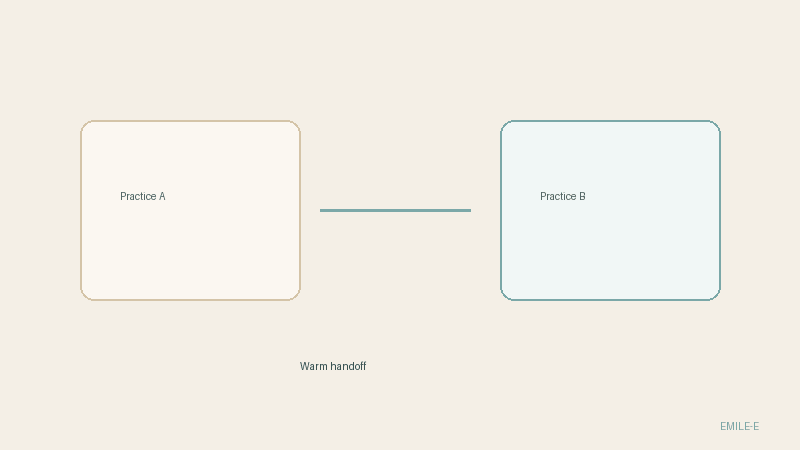
What warm referral networks feel like from the practice side
Independent and group practices already do pieces of this by instinct. A trusted colleague. A text that says "I have someone who needs you Friday." A shared sense of who is strong with trauma, teens, couples, or complex medical comorbidity.
The hard part is making that instinct durable when volumes rise, staff turn over, or the referring clinician is underwater.
A warm network is less about a bigger directory and more about a living map:
- Who has real openings this week?
- Who matches which clinical and practical constraints?
- Who will close the loop so the referring practice knows the person landed?
When that map lives only in one person's head, access fails the moment that person is out.
When that map is shared, lightweight, and owned, referrals stop feeling like gambling with someone else's hope.
The Access Test for your own front door
Before you redesign marketing, run the four questions against your own intake.
Find: Is it obvious how to reach a human who can help triage, not only how to submit a form into silence?
Afford: Can someone understand cash, insurance, and waitlist realities without decoding jargon?
Qualify: Do you say clearly who you are a good fit for, and who you are not, so people do not bounce after a wasted intake?
Stay connected: When you cannot take someone, do you offer a named next step (another clinician, another practice, a time window), or a polite dead end?
If question four is weak, you are accidentally training the community to restart the search every time a door closes. That is how "I tried therapy" becomes "therapy did not work," when what failed was the handoff.
Coordination is the product
EMILE-E builds for the practice side of this problem. Not as a louder marketplace. As quieter coordination.
Practice OS is how a clinic keeps the operational truth in one place: openings, caseload, handoffs, follow-ups, the unglamorous continuity work that turns a referral into a first session and a first session into a relationship that can hold.
If a soft next step is useful: Practice OS is $89 per clinician per month. Optional white-glove data migration is $2,500. Self-serve migration is free.
No invented urgency. No fake waitlist percentages. Just the thesis: discovery without handoff is not access.
Closing
The Access Test is simple on purpose.
Find. Afford. Qualify. Stay connected.
If your community can answer all four without disappearing between practices, you do not have a referral crisis. You have a network.
If they can only answer the first, you have a directory with a human cost.
This week, pick one referral path you use often. Walk it as if you were the person asking for help. Notice where the warmth ends. That is the work.
The Unburdening is EMILE-E's practice-side letter on building mental health infrastructure that holds. Quiet coordination over cold directories.