The Assignment Test: Why a Shared Client Should Not Mean Shared Sessions
Two clinicians, one client, one chart. The Assignment Test is four questions any practice can ask, including of us: only yours shown, only yours changed, nothing orphaned, sharing on purpose.

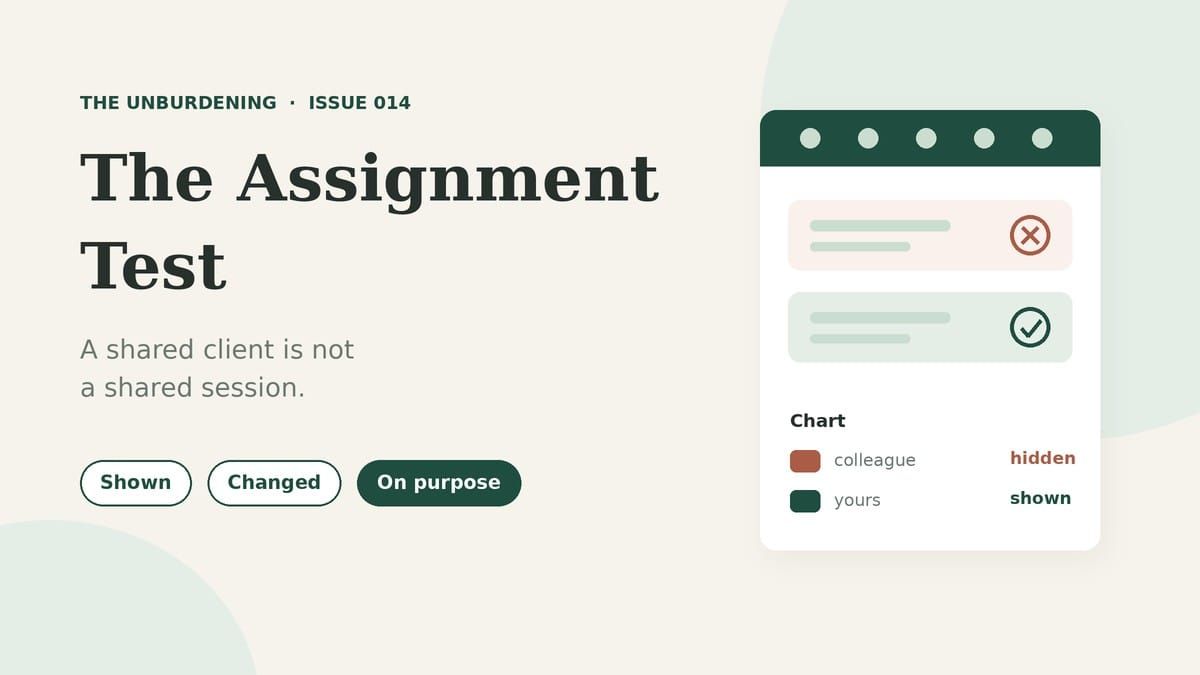
A client sees two clinicians at the same practice.
One handles individual sessions. The other runs a group the client joined last month. Both open the same chart. That is how shared care is supposed to work. The risk is not the shared chart. The risk is what a shared chart quietly lets each person see and touch that was never theirs.
A session belongs to the clinician who holds it. Sharing a client is not the same as sharing every appointment.
This Issue of The Unburdening names an Assignment Test for independent and small-group practices: when more than one clinician works with a client, does each person see and act on their own work, or on everyone's?
Shared care still has edges
Small practices share clients all the time. A couples clinician and an individual clinician. A primary clinician and a group lead. A clinician covering while a colleague is out.
None of that is a problem. It is often the best care a practice can offer. But a chart that shows every session to every clinician turns a clean handoff into a blurry one. A colleague's appointment sitting in your list, with buttons that work, is an invitation to a mistake nobody meant to make.
If the system cannot tell whose session is whose, the clinicians have to remember it for the system. That is the kind of weight a tool is supposed to carry.
The Assignment Test
Pick a client in your system who sees more than one clinician. Open the chart as each of them. Score each answer: solid, workable, or brittle.
- Only yours is shown. When a clinician opens a shared chart, do they see the sessions assigned to them, or every session the client has with anyone?
- Only yours can be changed. Can a clinician mark a colleague's session completed, a no-show, or a late cancel? Does the system stop it, or only hope nobody tries?
- Nothing is orphaned. When a session has no assigned clinician, or belongs to an account that was switched off, is there one clear person who can still act on it?
- Sharing is on purpose. Where clinicians do share something, is it a stated choice the practice made, or a side effect of how the screen was built?
If any one of those four is brittle, the chart spent trust even if nobody has made a mistake yet. Most practices never notice this until the day someone marks the wrong session.
The earlier tests still apply
The Presence Test asks whether a tool reduces cognitive load at the moment of care. The Front Door Test asks whether a client can find the next step. The Update Test asks whether every change earns trust instead of spending it. The Draft Test asks whether clinician work in motion stays put. The Claims Test asks whether getting paid protects the room. The Access Test asks whether a person who cannot be seen stays connected. The Waitlist Test asks whether offering a spot keeps the person waiting small. The Count Test asks whether a number survives an edit. The Receipt Test asks whether proof of payment reaches the right hands without a favor.
The Assignment Test is narrower than all of those. It asks what a shared chart does with work that belongs to one person.
A full chart can feel like transparency. Seeing everything is not the same as being responsible for everything.
Holding ourselves to it
We should be graded by the same four questions, so here is a recent example of our own instead of a hypothetical.
During testing on our own demo accounts, we opened a shared client's chart as one clinician and found a colleague's session in the Appointments tab. The buttons to mark it completed or record a no-show worked. The same session also showed up in that clinician's note session picker. The calendar already hid other clinicians' sessions. The chart did not. That was a gap, and we ruled on it plainly: a clinician should not see or act on sessions assigned to another clinician.
A Practice OS release that went live on 2026-10-13 changed that. In a client's chart, the Appointments tab, the session picker on a new note, and the session picker on a form now show a clinician their own sessions. The system refuses a clinician's change to a colleague's session, and signing a note will not complete a session that belongs to someone else.
Two kinds of sharing stay, because they are choices rather than accidents. A client's primary clinician can still see and act on that client's unassigned sessions, including ones left behind by an account that was switched off, so nothing gets stranded. Care team clinicians can still read each other's unsigned draft notes, read only, so coordination does not depend on a hallway conversation. Psychotherapy notes stay private. Owners and office staff keep the access they already had to run the schedule.
Here is the honest limit. This release changes what the chart shows and what a clinician is allowed to change. We are still tightening the layers underneath it, and that work is not finished. We would rather say that plainly than call it done.
Run the four questions on that change and the grade is solid on all four for what the chart shows and allows, because each piece of sharing that remains was named on purpose. The layers underneath are still in progress. If a future change of ours fails one of the four, the test should catch it, and we would want to hear about it.
What good looks like (without theater)
You do not need a security team. You need a habit a busy practice can keep whenever clients are shared.
Only yours is shown: a clinician's list is their own work.
Only yours can be changed: a colleague's session is not one click away.
Nothing is orphaned: an unassigned session has a clear owner.
Sharing is on purpose: what clinicians share is a decision, written down.
Wherever the answer is "I just knew not to touch that one," that is the design problem. Not a clinician problem.
What to audit this week
Find two clients who see more than one clinician. Open each chart as each clinician. Score Shown / Changed / Orphans / On purpose.
If you cannot say who is allowed to close out a session whose clinician left the practice, that is your first score.
Strengthen the brittle ones first. Tool shopping second.
Coordination is the product
EMILE-E builds for the practice side of this reality. Practice OS is meant to keep operational truth coherent so scheduling, notes, claims, and reports stop living as separate improvisations. VibedIn and Sesh sit in that same family when the practice chooses them.
If a soft next step is useful: Practice OS is $89 per clinician per month. VibedIn is $49 per month. Sesh is $10 per clinician per month.
No invented urgency. No fake breach stories. Just the thesis: a shared client should not mean shared sessions.
Closing
Two clinicians can care for the same person without stepping on each other's work.
Only yours is shown. Only yours can be changed. Nothing is orphaned. Sharing is on purpose.
Score the four. Strengthen the brittle ones. Keep each person's work their own.
That is how a shared chart keeps the trust it was given.
The Unburdening is EMILE-E's practice-side letter on building mental health infrastructure that holds. Quiet coordination over tool sprawl.