The Signature Test: Why a Treatment Plan Should Reach the Person It Is About
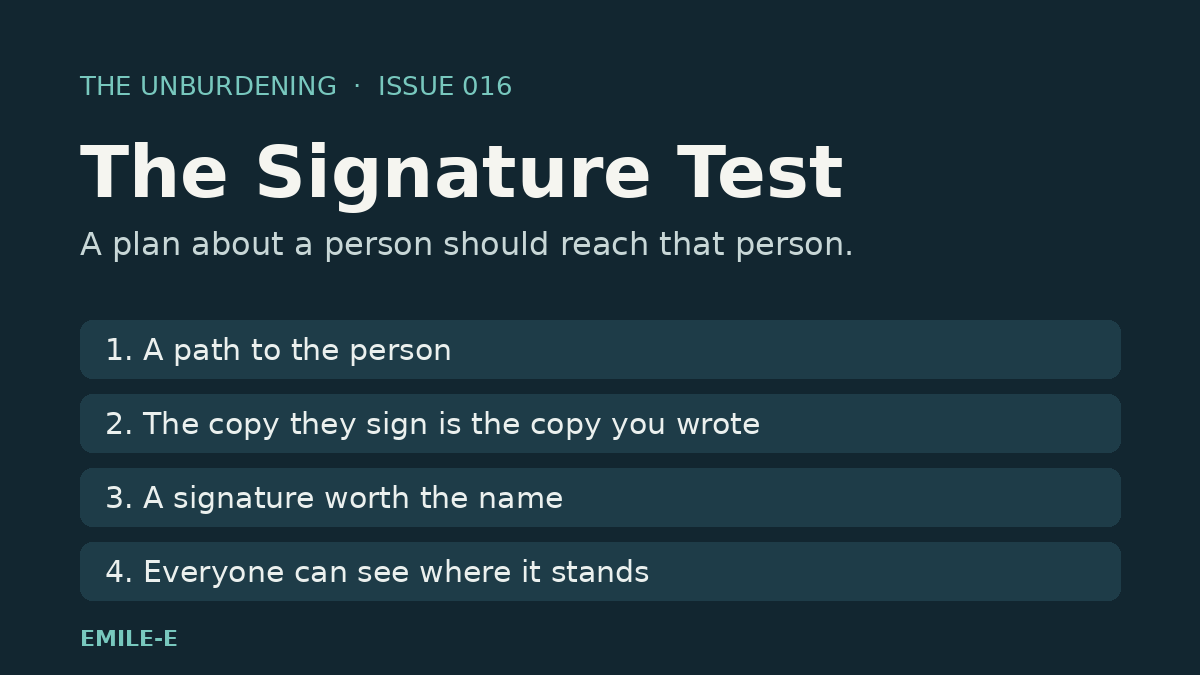
A signed plan the client never sees is only half an agreement. The Signature Test is four questions any practice can ask, including of us: a path to the person, a frozen copy, a real signature, a visible state.

A clinician finishes a treatment plan, reads it over, and presses Save and sign.
As far as the software is concerned, the plan is done. It sits in the chart, signed and dated. But the person the plan is about has never seen it. They were in the room when the goals were talked through, and they may remember most of it. They have nothing in hand, and nothing they agreed to in writing.
That is not negligence. It is what happens when a tool treats signing as the end of the work, rather than the start of a shared agreement.
This Issue of The Unburdening names a Signature Test for independent and small-group practices: when a plan is about a person, does it reach that person, and can they agree to it as easily as they agreed to their intake forms?
The plan nobody sent
Treatment plans are some of the most important documents a practice writes. They say what the work is for. They name the goals the client and clinician will hold each other to.
They are also, in many systems, documents only staff ever open. A clinician can sign one in a minute. Getting it to the client is another matter: print it, scan it, attach it to an email, chase a signature on paper, file the copy. Every one of those steps is a place where the plan quietly stops moving.
When that happens, nobody has done anything wrong. The tool just never had a path from the chart to the client.
The Signature Test
Ask whoever maintains your practice software, or try it yourself. Score each answer: solid, workable, or brittle.
- A path to the person. Once a plan is signed, can it be sent to the client from the same place it was signed, without leaving the system?
- The copy they sign is the copy you wrote. Is the version the client sees frozen at the moment it was sent, so an edit afterward cannot quietly change what they agreed to?
- A signature worth the name. Does the client sign the same way they signed their consents, with an agreement and their own name, and is the time and device recorded on the server rather than taken on trust?
- Everyone can see where it stands. Can staff tell whether a plan is waiting, opened, signed, withdrawn or replaced, without asking the client?
If any one of those four is brittle, the plan is carrying more weight than the workflow behind it. Good intentions do not travel by themselves.
The earlier tests still apply
The Presence Test asks whether a tool reduces cognitive load at the moment of care. The Front Door Test asks whether a client can find the next step. The Update Test asks whether every change earns trust. The Draft Test asks whether work in motion stays put. The Claims Test asks whether getting paid protects the room. The Access Test asks whether a person who cannot be seen stays connected. The Waitlist Test asks whether offering a spot keeps the person waiting small. The Count Test asks whether a number survives an edit. The Receipt Test asks whether proof of payment reaches the right hands. The Assignment Test asks whether a shared chart keeps each person's work their own. The Log Test asks whether your software keeps your people out of its diary.
The Signature Test is the one about the person the plan was written for. It asks whether they are a participant or just a subject.
Holding ourselves to it
We should be graded by the same four questions, so here is a recent example of our own instead of a hypothetical.
A clinician using Practice OS told us a plan she had signed never showed up in her client's app. When we looked, the answer was plain and a little uncomfortable: she had done everything right. There was simply no way to send a treatment plan to a client at all. Signing it was the last step the software offered.
A Practice OS release that is now live in production changed that. When a clinician signs a plan, the sign step now offers to send it to the client to sign in the app, and a practice can choose whether that box starts ticked. Any active plan can also be sent to sign, or shared just to read, later on, so a plan signed before this change can still go out without anyone repairing data. That is the first question.
The client receives a frozen copy of the plan, with a fingerprint taken when it was sent, so the version they read is the version they sign. If the plan is amended, the new version replaces the open copy rather than changing it underneath them. That is the second question.
The client signs the same way they sign intake consents: they agree to the practice's own wording and type their full legal name. The time comes from the server, and the device is recorded. The signed PDF is filed in the chart's treatment plan folder and shared back with the client. That is the third question.
Staff can see each plan's state: waiting, opened, not on the app, held for co-sign, signed, withdrawn, or replaced. They can send a reminder once a day, withdraw a copy, or download the PDF. When a plan needs a supervisor's co-signature, it waits for that before it goes out. That is the fourth question.
Here is the honest limit. A client who does not use the app cannot sign in it, and staff will see that state rather than a signature. Clients on older versions of the app get the PDF instead of the full signing screen. And none of this replaces the conversation in the room. A signature records an agreement. It does not create one.
Run the four questions on that change and the grade is solid on all four for clients on the app, and workable for the ones who are not. If a future change of ours fails one of the four, the test should catch it, and we would want to hear about it.
What good looks like (without theater)
You do not need a new portal. You need a few plain questions and a vendor willing to answer them.
- A path to the person: the plan goes from the chart to the client in one step.
- The copy they sign is the copy you wrote: what they agree to cannot shift after it is sent.
- A signature worth the name: the same care as a consent, with the time and device recorded.
- Everyone can see where it stands: staff know the state without chasing the client.
Wherever the answer is "we print it and hope," that is the design problem. Not a staff problem.
What to audit this week
Pick one client whose plan was signed this month. Ask whether that client has a copy, and whether they have agreed to it in writing.
If nobody can answer without checking a drawer, that is your first score.
Strengthen the brittle ones first. Tool shopping second.
Coordination is the product
EMILE-E builds for the practice side of this reality. Practice OS is meant to keep operational truth coherent so scheduling, notes and billing stop living as separate improvisations, including the documents that belong as much to the client as to the chart. VibedIn and Sesh sit in that same family when the practice chooses them.
If a soft next step is useful: Practice OS is $89 per clinician per month. VibedIn is $49 per practice per month. Sesh is $10 per clinician per month.
Closing
A plan is a promise between two people. Neither of them should have to take it on faith.
A path to the person. The copy they sign is the copy you wrote. A signature worth the name. Everyone can see where it stands.
Score the four. Strengthen the brittle ones. Put the plan in the hands of the person it is about.
That is how a practice keeps the trust it was given, one agreement at a time.
The Unburdening is EMILE-E's practice-side letter on building mental health infrastructure that holds. Quiet coordination over tool sprawl.