The Receipt Test: Why Proof of Payment Should Not Depend on a Favor
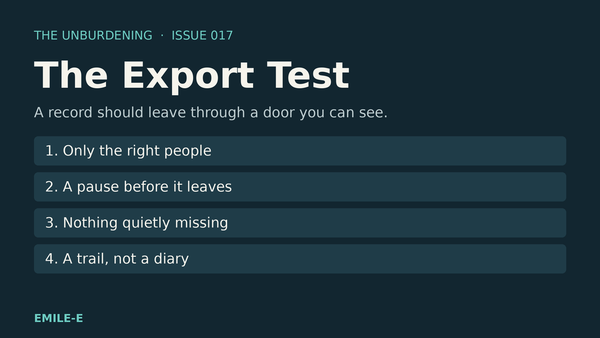
A client needs proof of payment. The Receipt Test is four questions any practice can ask, including of us: reachable without a favor, nothing on the envelope, the right hands, the office is told.

A client stops at the front desk on the way out.
They need a receipt for their HSA or FSA claim. Someone at the desk says of course, finds the bill, and emails it later, or prints it, or makes a note for tomorrow. That instinct is service. The risk is not the request. The risk is everything that has to go right, by hand, for one piece of paper to reach the right person and no one else.
A receipt is not a formality. It is proof that someone paid for care, and it carries the fact of that care with it.
This Issue of The Unburdening names a Receipt Test for independent and small-group practices: when a client needs proof of payment, can they get it without a favor, and does the asking stay private?
Proof of payment is a quiet kind of care
Practices rarely think of receipts as part of the work. But for the client, a receipt can be the difference between being reimbursed and quietly absorbing the cost of therapy.
Asking for one can also be uncomfortable. It means saying out loud that money matters enough to chase, then waiting on someone else's inbox. And every handoff (a download, an attachment, a forwarded email, a printout on the counter) is another place a private fact can land in the wrong spot.
The tool either makes that request routine, or turns it into a favor.
The Receipt Test
Pick the last few times a client asked for a receipt or a year of statements. Score each one: solid, workable, or brittle.
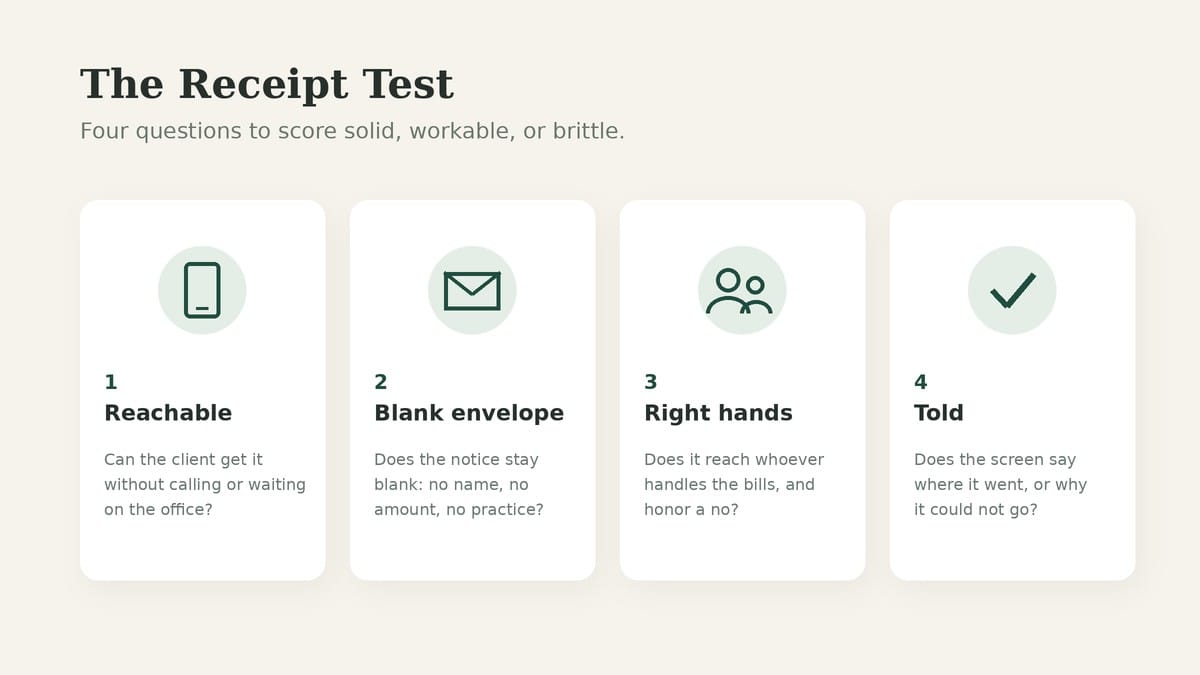
- Reachable without a favor. Can the client get their own receipt, from where they already manage their bills, without calling or waiting on the office?
- Nothing on the envelope. When the office lets a client know a receipt is ready, does the notice itself stay blank (no name, no amount, no practice name), so it is safe if someone else sees the screen?
- The right hands. Does it go to the person who actually handles the bills (a parent, for a teen), and does it respect a client who asked not to get billing email?
- The office is told. After someone sends it, does the screen say where it went, or plainly why it could not go?
If any one of those four is brittle, the receipt spent trust even if it eventually arrived. Clients rarely complain about a slow receipt. They just stop asking.
The earlier tests still apply
The Presence Test asks whether a tool reduces cognitive load at the moment of care. The Front Door Test asks whether a client can find the next step. The Update Test asks whether every change earns trust instead of spending it. The Draft Test asks whether clinician work in motion stays put. The Claims Test asks whether getting paid protects the room. The Access Test asks whether a person who cannot be seen stays connected. The Waitlist Test asks whether offering a spot keeps the person waiting small. The Count Test asks whether the numbers still tell the truth after a record changes.
The Receipt Test sits on the other side of the Claims Test. Claims asks how the practice gets paid. This test asks whether the client can prove they paid, without the proof becoming its own small exposure.
Holding ourselves to it
We should be graded by the same four questions, so here is a recent example of our own instead of a hypothetical.
Until recently, the Practice OS client app on iPhone and Android had no way to get a receipt. The website did, so a client using their phone still had to ask.
A Practice OS release that went live on 2026-10-06 changed that. In the app, the Billing tab now shows Get receipt on bills that have a payment on them, and a button for a full year statement of bills and payments. Each opens as a PDF the client can save, print, or share. The app opens it through a short-lived link that checks the client's sign-in each time it is opened.
The same release added Send receipt to client for staff who handle billing (owners, office staff, and billing admins; clinicians do not see the button). It goes to the people who handle the bills on that chart, so a teen's receipt goes to the parent. A client with the app gets a notification. Anyone else gets a short email with a sign-in link. Neither one shows the client's name, the amount, or the practice name. It never emails a client marked as not wanting billing email. And the screen tells staff where it went, or why it could not go.
Run the four questions on that release. Reachable without a favor: solid, in the app as well as on the web. Nothing on the envelope: solid, by design. The right hands: solid for the cases the release names. The office is told: solid.
Here is the honest limit. This letter does not grade what is printed on the receipt itself, or whether every benefits administrator will accept it as written. We have not checked that against every plan, and we will not claim it. If an administrator needs something the receipt does not show, we would want to hear about it.
What good looks like (without theater)
You do not need a billing department. You need a habit a busy practice can keep.
Reachable: the client can get it from where they already pay.
Blank envelope: the notice says ready, and nothing more.
Right hands: it goes to whoever handles the bills, and honors a no.
Told: staff can say where it went without guessing.
Wherever the answer is "they had to ask twice," that is the design problem. Not a client problem.
What to audit this week
List the last five receipt or statement requests your practice handled. For each, score Reachable / Envelope / Hands / Told.
If you cannot tell whether the last receipt your office sent actually reached anyone, that is your first score.
Strengthen the brittle ones first. Tool shopping second.
Coordination is the product
EMILE-E builds for the practice side of this reality. Practice OS is meant to keep operational truth coherent so scheduling, notes, claims, billing, and the client app stop living as separate improvisations. VibedIn and Sesh sit in that same family when the practice chooses them.
If a soft next step is useful: Practice OS is $89 per clinician per month. VibedIn is $49 per month. Sesh is $10 per clinician per month.
No invented urgency. No fake billing charts. Just the thesis: proof of payment should not depend on a favor from the front desk.
Closing
They paid for care. Proving it should not cost them a phone call, or their privacy.
Reachable without a favor. Nothing on the envelope. The right hands. The office is told.
Score the four. Strengthen the brittle ones. Keep the paper trail quiet.
That is how a receipt keeps the trust it was given.
The Unburdening is EMILE-E's practice-side letter on building mental health infrastructure that holds. Quiet coordination over tool sprawl.