The Claims Test: Why Getting Paid Is Part of Keeping the Room
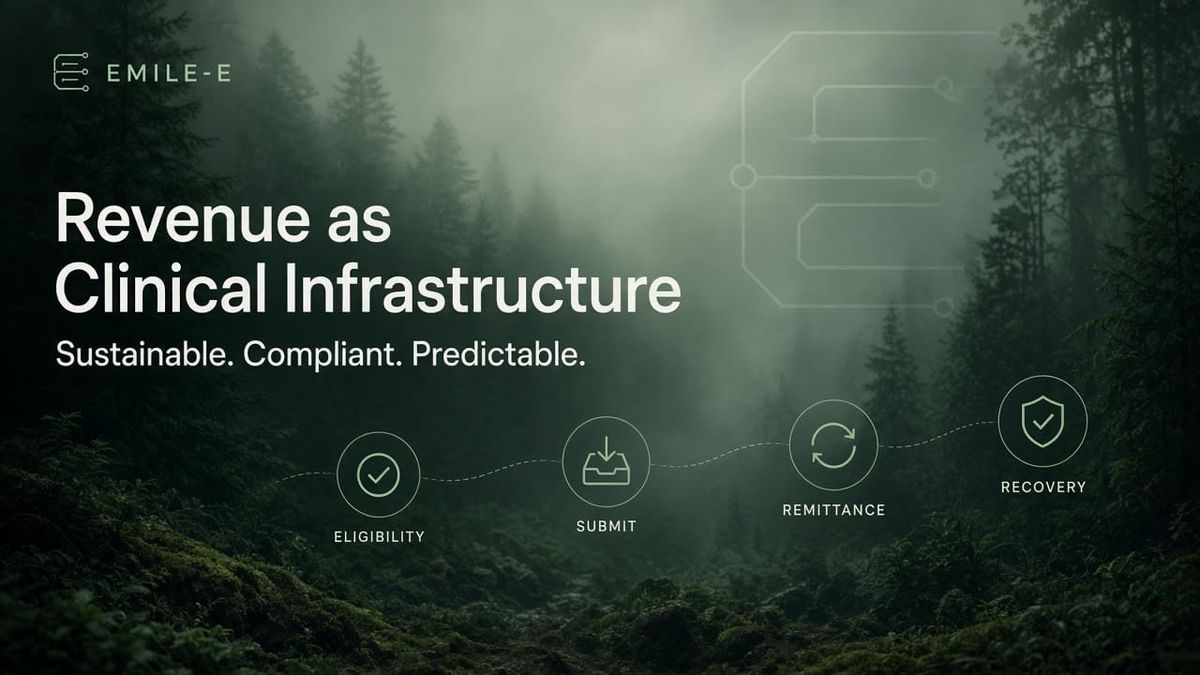
For independent practices, getting paid is clinical infrastructure. Four jobs: eligibility truth, clean submit, remittance clarity, owned recovery.

Someone sits across from you. Attention is scarce. Trust is fragile. The work is real.
Then the hour ends, and a second shift starts: eligibility that was "fine until it wasn't," a claim that needs one more field, a remittance that reads like a puzzle, a denial that nobody owns. None of that is optional. It is how the practice stays open. It is also how the week disappears.
This week in The Unburdening we name a quieter truth: for independent and small-group practices, getting paid is clinical infrastructure. Not because money is the mission. Because unpaid chaos steals the presence the mission needs.
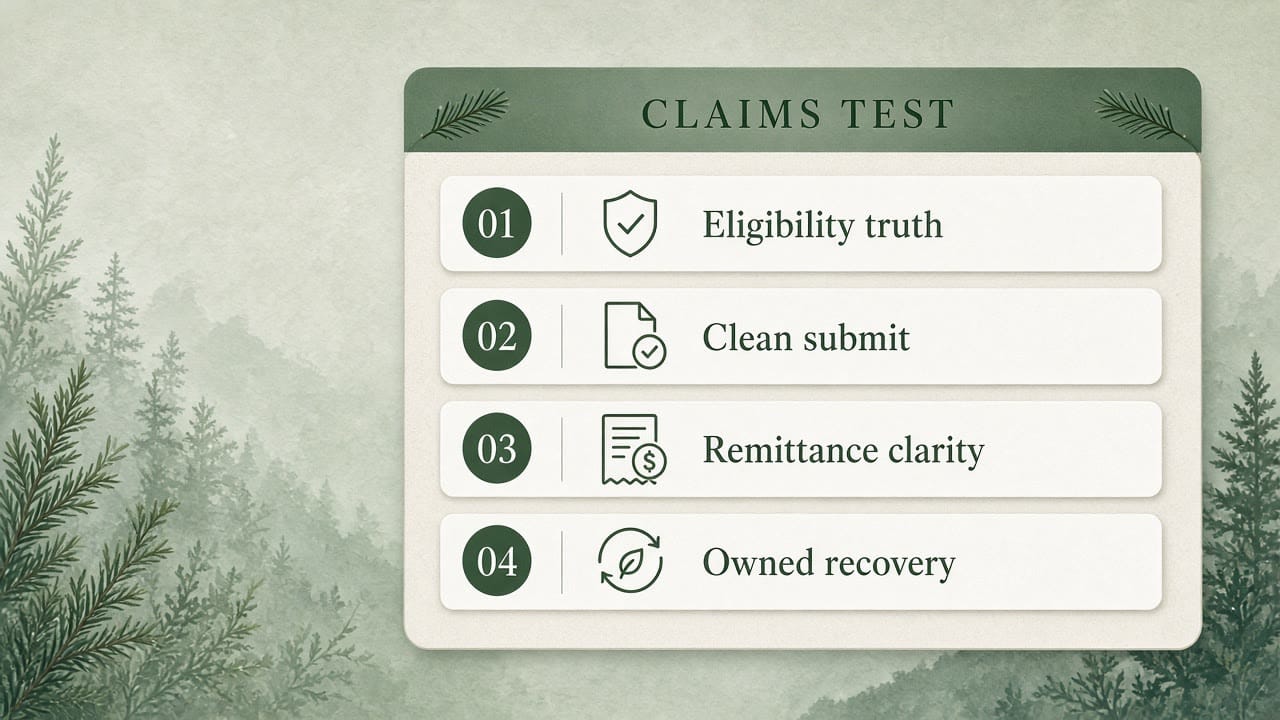
The Claims Test
A claim is not a PDF. It is a chain of answers that have to stay true together.
- Eligibility truth before the hour. Do you know the coverage path before the session starts, or do you discover the mismatch after someone already sat down?
- 2. Clean submit without re-charting. Can claim data flow from clinical truth, or does someone retype the week into a second system?
- 3. Remittance clarity. Can you see what paid, what denied, and what is still pending without a scavenger hunt across portals and inboxes?
- 4. Owned recovery. When something stalls or denies, is there a named next step and an owner, or only hope and after-hours detective work?
If any one of those four is brittle, the practice is already running a revenue platform. It is just an informal one, held together by memory and overtime.
Why "billing" is the wrong frame
Larger organizations had departments for eligibility, coding support, and denial management. Independent clinicians inherited the outcomes without the headcount.
So the market sold tools. Some help. Some add another login and another half-truth about automation. The clinician or the one admin who keeps the lights on becomes the integration layer again: the person who remembers which payer wants which subscriber ID format, which rejection is noise, and which one will become a write-off if nobody moves today.
That is not a character flaw. It is a design failure in the surrounding stack.
Presence still wins
The Presence Test has not changed. Does this reduce cognitive load at the moment of care, or add another field, tab, or portal? Who does this serve when clinical time and admin time conflict?
The Claims Test sits beside Presence and the Platform Test. Presence asks whether the hour stays human. Platform asks whether acquisition, scheduling, documentation, communication, and continuity hold without burning the human who runs them. Claims asks whether the money path protects those jobs, or quietly taxes them every afternoon.
A practice can pass discovery and still fail here. A beautiful front door does not fund the week if remittance is fog and denials are orphans.
What good looks like (without theater)
You do not need a hospital billing department. You need answers that survive a busy Tuesday.
Eligibility truth: coverage path checked early enough to set expectations, not after the session is a sunk cost.
Clean submit: clinical documentation and claim fields stop living as two disconnected stories.
Remittance clarity: paid, denied, and pending is readable in one place the practice actually uses.
Owned recovery: every open denial or stall has a next action and a person responsible, even if that person is you with a defined window.
Wherever the answer is "only in my head," that is the next design problem. Not a pep talk. A clarity chase.
What to audit this week
Pick five recent sessions or five recent claims and score each Claims Test job: solid, workable, or brittle.
Eligibility: Did anyone know the real path before the hour?
Submit: Was the claim a clean handoff from chart truth, or a second writing job?
Remittance: Could a trusted colleague reconstruct status without asking you?
Recovery: Are open items owned, or floating?
Strengthen the brittle ones first. Tool shopping second.
Coordination is the product
EMILE-E builds for the practice side of this reality. Practice OS is meant to keep operational truth, including the revenue path that funds care, coherent so eligibility, documentation, and follow-through stop living as separate improvisations.
If a soft next step is useful: Practice OS is $89 per clinician per month. Optional white-glove data migration is $2500. Self-serve migration is free. Soft packages: Lobby Ready adds VibedIn at $29 per month. Full Ecosystem adds VibedIn at $29 per month plus Sesh at $6 per clinician per month. A la carte Sesh alone stays $10 per clinician per month.
No invented urgency. No fake denial rates. Just the thesis: if revenue work already shapes your week, make it intentional.
Closing
You did not ask for a second shift after the hour. The payer stack asked it of you.
Eligibility before the hour. Clean submit. Remittance clarity. Owned recovery.
Score the four. Strengthen the brittle ones. Protect the room.
That is how a practice stays human while the money path gets real.
The Unburdening is EMILE-E's practice-side letter on building mental health infrastructure that holds. Quiet coordination over tool sprawl.