The Count Test: Why a Cancellation Should Not Disappear When the Session Comes Back
When a record changes, do your numbers still tell the truth about what happened? A four-question Count Test for practices, and a recent fix of our own.

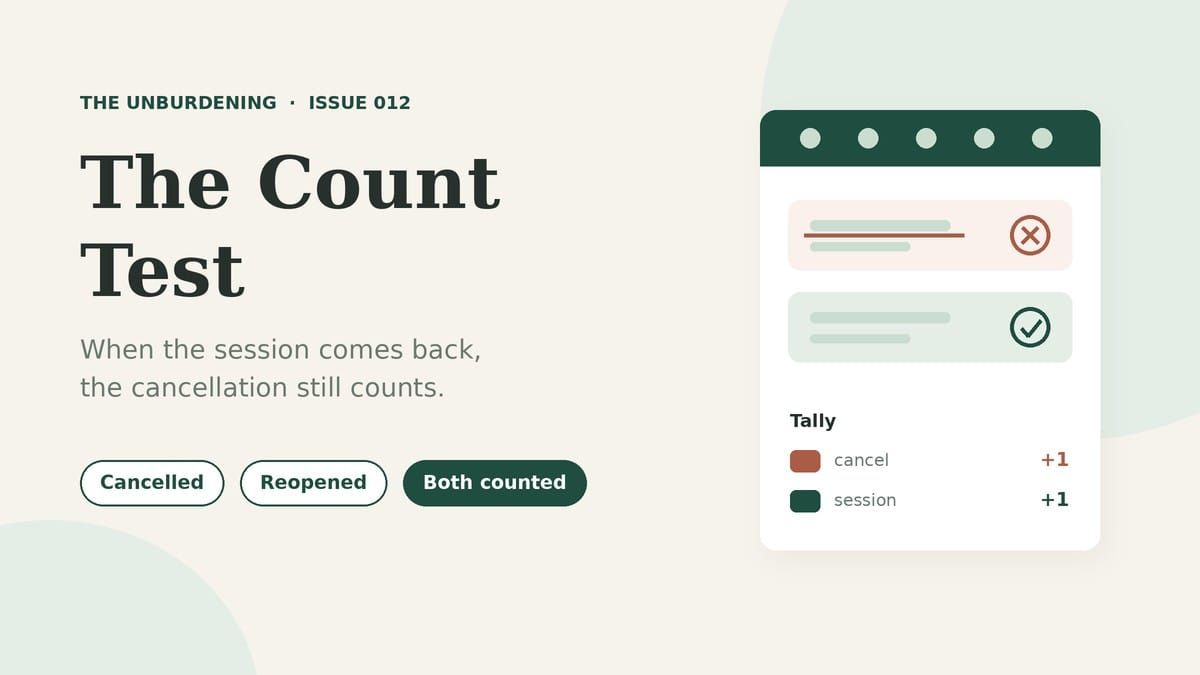
A session gets cancelled on a Monday.
On Thursday the client reaches back out, and the practice reopens the same appointment instead of booking a fresh one. That instinct is kindness. It keeps the door open and saves a few clicks. The risk is not the reopen. The risk is what the numbers quietly forget once the session looks normal again.
A cancellation is not a typo. It is a real event in a real week, and someone may need to see it later.
This Issue of The Unburdening names a Count Test for independent and small-group practices: when a record changes, do your numbers still tell the truth about what happened, or only about how things look right now?
Counts are a kind of memory
Practices lean on counts more than they say out loud. How many sessions were cancelled this month. How a clinician's caseload is really moving. Whether a pattern of late cancellations is starting to form for one client, or across a schedule.
None of those questions are about blame. They are about care and about running a practice honestly. A clinician who sees a cluster of cancellations may want to check in. An owner looking at a month may want to know whether the calendar was as full as it looked.
If the count can be erased by a later edit, the practice is not looking at its history. It is looking at its latest draft.
The Count Test
Pick a few records in your system that changed after the fact (a reopened session, a corrected status, a rebooked appointment, an edited outcome). Score each one: solid, workable, or brittle.
- The event survives the edit. If something really happened, does it still count after the record changes, or does the change wipe it out?
- It counts where it happened. Does the event stay on its original day, for the person responsible at the time, or does it drift to wherever the record lives now?
- Corrections stay corrections. Can the system tell a real new event apart from fixing a mistake, so honest corrections do not inflate the numbers?
- The person acting is told. When someone makes the change, does the screen say plainly what will and will not count afterward?
If any one of those four is brittle, the report spent trust even if every number on it adds up. People rarely complain that a count is wrong. They just stop believing the dashboard.
The earlier tests still apply
The Presence Test asks whether a tool reduces cognitive load at the moment of care. The Front Door Test asks whether a client can find the next step. The Update Test asks whether every change earns trust instead of spending it. The Draft Test asks whether clinician work in motion stays put. The Claims Test asks whether getting paid protects the room. The Access Test asks whether a person who cannot be seen stays connected. The Waitlist Test asks whether offering a spot keeps the person waiting small.
The Count Test is narrower than all of those. It asks what happens to the truth after someone edits a record. The Draft Test protects work in motion. This test protects work that already happened.
A tidy calendar can still tell a false story. Looking clean is not the same as being accurate.
Holding ourselves to it
We should be graded by the same four questions, so here is a recent example of our own instead of a hypothetical.
Until recently, Practice OS counted every session by its current status. That meant reopening a cancelled session removed the cancellation from the counts. Our own written guidance at the time described that behavior as intended. It was backwards, and we said so.
A Practice OS release that went live on 2026-10-05 changed the rule. Reopening a cancelled session now counts the same as a cancellation plus a new booking. The cancellation counts once, on its original day, for the clinician the session belonged to then. The reopened session counts by its own outcome on its own date. The caseload view and the practice reports follow that rule. Provider pay leaves the kept cancellation out, because a reopen does not change any money.
Reopening a no-show, a completed session, or a declined request records nothing extra, because those are corrections to an outcome rather than a new event. A session that carries a kept cancellation can no longer be deleted. And the reopen confirmation now tells the person acting that the cancellation still counts, and suggests booking a new session instead.
Here is the honest limit. Reopens that happened before this change cannot be filled back in, because the old record did not keep the session date needed to place them. So history before that release may still undercount some cancellations. We would rather say that plainly than let a report look more complete than it is.
Run the four questions on that change and the grade is solid on all four going forward, and incomplete for the past. If a future change of ours fails one of the four, the test should catch it, and we would want to hear about it.
What good looks like (without theater)
You do not need an audit department. You need a habit a busy practice can keep before trusting a number.
The event survives the edit: what happened still counts after the record changes.
It counts where it happened: the original day, the person responsible then.
Corrections stay corrections: fixing a mistake does not create a new event.
The person acting is told: the screen says what will count before they confirm.
Wherever the answer is "the report changed and nobody could say why," that is the design problem. Not a clinician problem.
What to audit this week
Find three records that changed after the fact this month. For each, score Survives / Where / Correction / Told.
If you cannot tell whether last month's cancellation total includes sessions that were later reopened, that is your first score.
Strengthen the brittle ones first. Tool shopping second.
Coordination is the product
EMILE-E builds for the practice side of this reality. Practice OS is meant to keep operational truth coherent so scheduling, notes, claims, and reports stop living as separate improvisations. VibedIn and Sesh sit in that same family when the practice chooses them.
If a soft next step is useful: Practice OS is $89 per clinician per month. VibedIn is $49 per month. Sesh is $10 per clinician per month.
No invented urgency. No fake attendance charts. Just the thesis: a cancellation should not disappear when the session comes back.
Closing
The week happened the way it happened, even if the calendar looks different now.
The event survives the edit. It counts where it happened. Corrections stay corrections. The person acting is told.
Score the four. Strengthen the brittle ones. Keep the record honest.
That is how a number keeps the trust it was given.
The Unburdening is EMILE-E's practice-side letter on building mental health infrastructure that holds. Quiet coordination over tool sprawl.