The Draft Test: Why Clinician Work Should Never Vanish Quietly
A draft is care in motion. The Draft Test is four questions any practice can ask of any clinical tool, including ours: save incomplete, Other means words, come back whole, fail out loud.

A clinician is mid-note. The session ran long. Someone knocks. A phone rings. They save what they can and step away.
When they come back, the draft is gone, or the form will not save because a required field is empty, or Other offered no place to type what they meant. The work did not fail loudly. It vanished, or refused, without a clear reason.
That is not a small glitch. In behavioral health, the draft is often the only record of what just happened in the room. If the tool spends that quietly, it spends trust.
This Issue of The Unburdening names a Draft Test for independent and small-group practices: when a clinician is still writing, does the software hold the work, or quietly make it disappear?
Notes are not a form to finish later
A finalized note is a finished record. A draft is care in motion. Between the two sits the real workday: interrupted sessions, incomplete assessments, words that do not fit a dropdown yet.
Clinicians do not write notes in one unbroken pass. They step out, they come back, they add a detail after the next client, they choose Other because the list missed the truth. The tool either respects that rhythm or it fights it.
When Save draft only works on a complete form, the software has confused "not ready to sign" with "not worth keeping." When Other has no text box, the software has decided the clinician's words do not count until they match a preset. Both spend trust the practice cannot see on a dashboard.
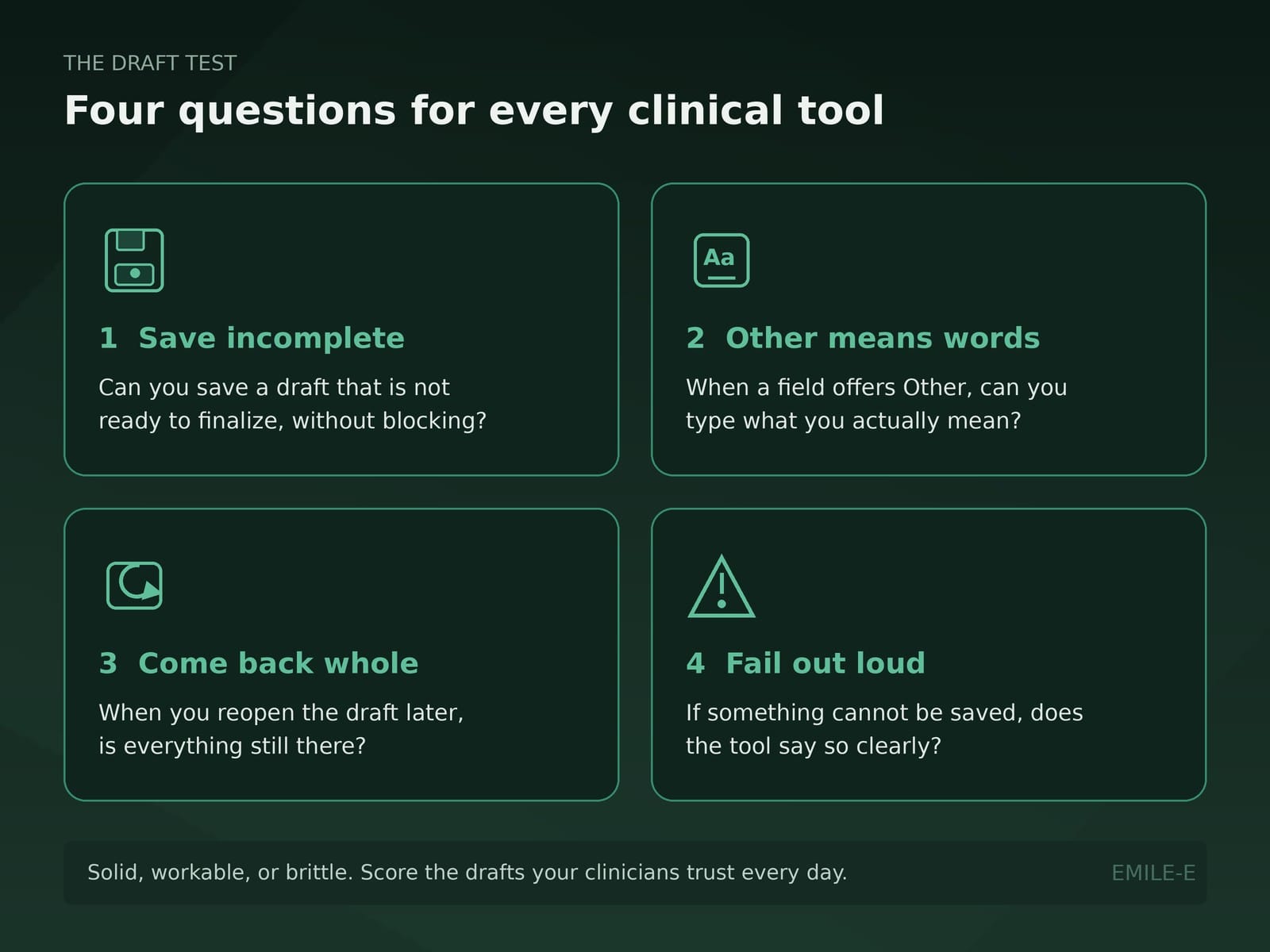
The Draft Test
Pick the clinical tools your clinicians use for notes, assessments, and treatment plans. Score each one: solid, workable, or brittle.
- Save incomplete. Can you save a draft that is not ready to finalize, without the form blocking you?
- Other means words. When a field offers Other, can you type what you actually mean?
- Come back whole. When you reopen the draft later, is everything still there as you left it?
- Fail out loud. If something cannot be saved, does the tool say so clearly, instead of pretending it worked or clearing the work?
If any one of those four is brittle, the tool spent trust even if the finalized note looks clean later. Clinicians rarely file tickets about vanished drafts. They rewrite, or they stop trusting Save, or they keep a second copy somewhere else. That is unpaid labor the software created.
Presence, Update, and Front Door still apply
The Presence Test asks whether a tool reduces cognitive load at the moment of care. The Front Door Test asks whether a client can find the next step without becoming unpaid staff. The Update Test asks whether every change earns trust instead of spending it.
The Draft Test sits on the clinician side of the same honesty. A tool can pass the Front Door for clients and still fail the Draft Test for the person writing the note. Trust is what the product keeps when no one is watching the form.
Holding ourselves to it
We should be graded by the same four questions, so here is a recent example of our own instead of a hypothetical.
Practice OS recently shipped a draft-integrity fix. The rule is simple: Save draft must work regardless of completeness. Finalize-only validation must not block drafts. Every Other option on clinical forms must allow text input. Garry locked the product principle as "This cannot happen" for silent draft loss.
Run the test on that standard. Save incomplete: a draft is allowed to be unfinished. Other means words: Other is not a dead end. Come back whole: the point of the fix is that the work stays. Fail out loud: quiet loss is the failure mode we refuse.
A ship proves the standard we are holding, not a scoreboard. No invented before/after metrics. If a future form of ours fails one of the four, the test should catch it, and we would want to hear about it.
What good looks like (without theater)
You do not need a vendor-management process. You need a habit a busy practice can keep.
Incomplete: Save draft works before every field is perfect.
Other: every Other path takes words.
Whole: reopen shows what was left, not a blank surprise.
Loud: a failed save says so, and does not clear the work as if nothing happened.
Wherever the answer is "we found out when a clinician rewrote the note," that is the design problem. Not a clinician problem.
What to audit this week
List the clinical tools your team uses for notes and assessments. For each, try to save an incomplete draft, use an Other field, reopen later, and force a failure path if you can.
Score Save / Other / Whole / Loud. Strengthen the brittle ones first. Tool shopping second.
Coordination is the product
EMILE-E builds for the practice side of this reality. Practice OS is meant to keep operational truth coherent so scheduling, notes, claims, and the client app stop living as separate improvisations. VibedIn and Sesh sit in that same family when the practice chooses the soft packages that fit.
If a soft next step is useful: Practice OS is $89 per clinician per month. VibedIn is $49 per practice per month. Sesh is $10 per clinician per month.
No invented urgency. No fake adoption charts. Just the thesis: clinician work in motion should never vanish quietly.
Closing
Your clinicians did not sign up to rewrite care that the software dropped. They signed up to hold the room, and the tools around that work must hold the draft.
Save incomplete. Other means words. Come back whole. Fail out loud.
Score the four. Strengthen the brittle ones. Keep the record honest.
That is how clinical software keeps the trust it was given.
The Unburdening is EMILE-E's practice-side letter on building mental health infrastructure that holds. Quiet coordination over tool sprawl.