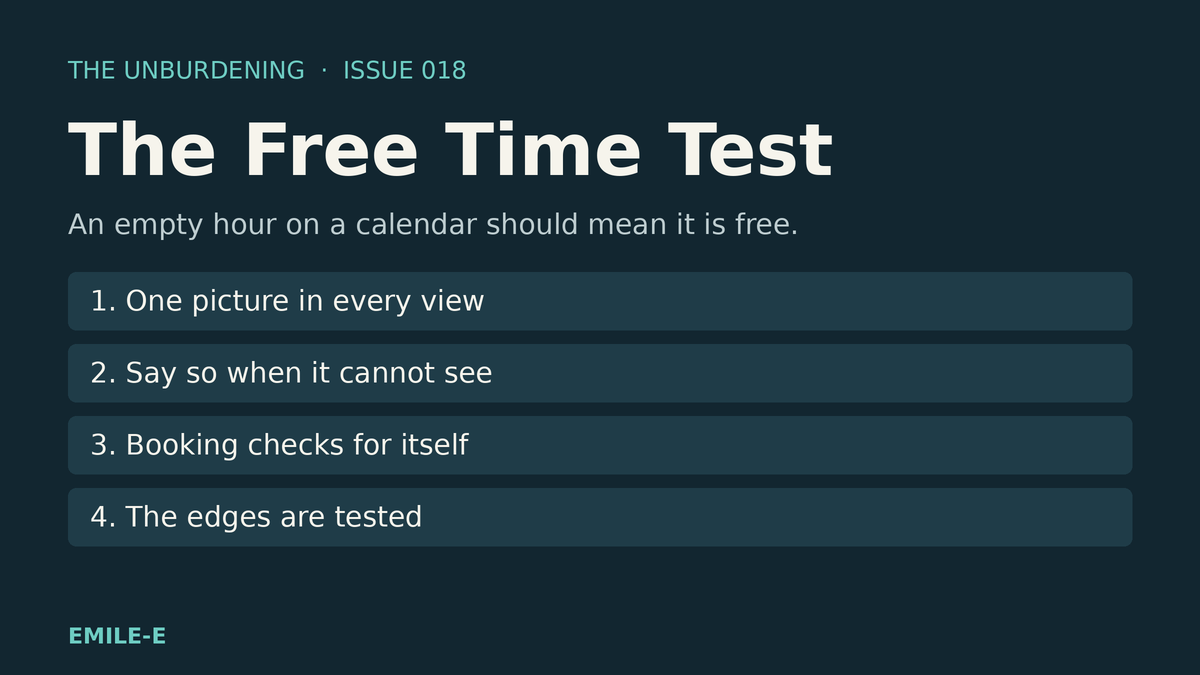
The Free Time Test: why an empty hour on a calendar should mean it is free

A clinician opens the month view to find an afternoon for a new client. Thursday looks wide open. So does the following Tuesday.
They are not open. One has a supervision block. The other is a school pickup that lives on a personal Google Calendar. The month view simply could not see either one.
In our case, the screen said so. A line across the top read: "Couldn't load blocked time and Google Calendar busy time, so those hours may look free." That warning did its job. It was also a sign that something underneath was not doing its job.
This Issue of The Unburdening names a Free Time Test for independent and small-group practices: when your calendar shows an hour as free, is it actually free, and does the calendar tell you when it cannot be sure?
The open slot that is not open
Every practice runs on a calendar. Sessions, supervision, admin time, the hours a clinician has kept for their own life. Most of that lives in more than one place, and the practice calendar has to pull it together to show a single picture.
When that pull fails quietly, the picture lies by omission. An empty square looks exactly like a free hour. Nobody types anything wrong. The tool just shows less than it knows, and the person reading it fills the gap with trust.
The Free Time Test
Ask whoever maintains your practice software, or try it yourself. Score each answer: solid, workable, or brittle.
- One picture in every view. Do the day, week and month views all show the same blocked time and outside busy time, or does one view quietly see less?
- Say so when it cannot see. If busy time cannot be loaded, does the calendar warn you, instead of drawing those hours as free?
- Booking checks for itself. When a time is actually booked, is it checked against real availability at that moment, so a gap in the display can never turn into a double booking?
- The edges are tested. Has anyone tried the long months, the six-week month grid, and the week the clocks change?
If any one of those four is brittle, your free time is a guess. Good intentions do not clear a calendar.
The earlier tests still apply
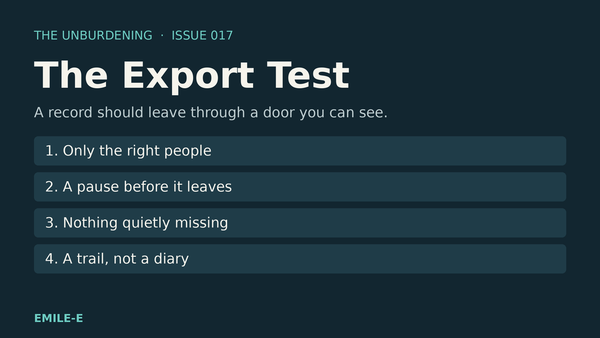
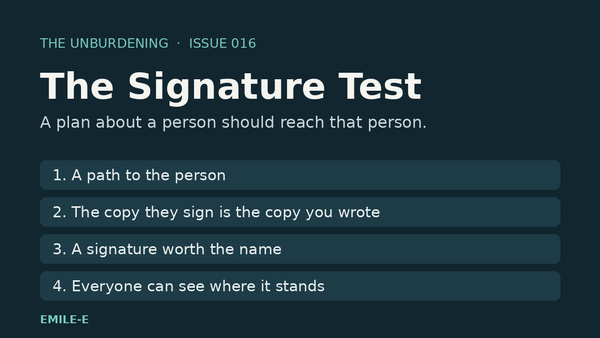
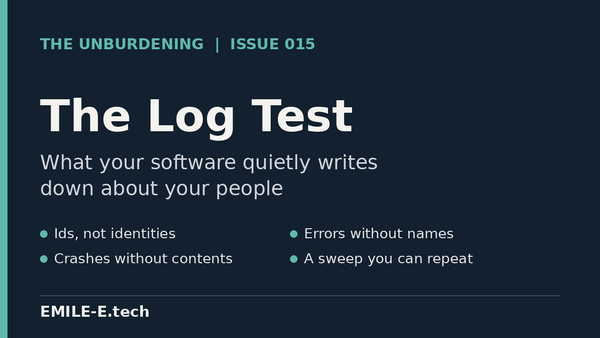
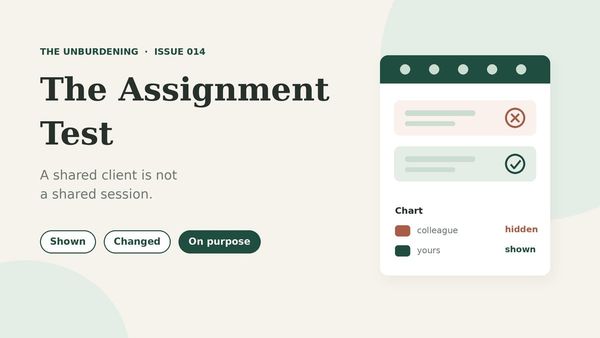
The Presence Test asks whether a tool reduces cognitive load at the moment of care. The Front Door Test asks whether a client can find the next step. The Update Test asks whether every change earns trust. The Draft Test asks whether work in motion stays put. The Claims Test asks whether getting paid protects the room. The Access Test asks whether a person who cannot be seen stays connected. The Waitlist Test asks whether offering a spot keeps the person waiting small. The Count Test asks whether a number survives an edit. The Receipt Test asks whether proof of payment reaches the right hands. The Assignment Test asks whether a shared chart keeps each person's work their own. The Log Test asks whether your software keeps your people out of its diary. The Signature Test asks whether a plan reaches the person it is about. The Export Test asks whether records leave through a door you can see.
The Free Time Test is the one about the empty square. It asks whether free means free.
Holding ourselves to it
We should be graded by the same four questions, so here is a recent example of our own instead of a hypothetical.
In Practice OS, the month view of the calendar was showing that warning for October and November. Blocked time and Google Calendar busy time were missing from the month view for those two months, so some hours looked free when they were not.
The cause was a limit we had set ourselves. The month view asks for its whole grid at once, Monday through Sunday, including the days from the months on either side. The system refused any request longer than 35 days. October's five-week grid ran just past that limit because it ends after the November clock change adds an hour, and November's grid is six weeks long. Both were turned away, so the month view had nothing to draw.
A Practice OS update that is now live in production raised that limit to six weeks plus two hours, enough for any month grid including a clock change. Tests now cover both of those months and a range that really is too long, and the month test fails on the old limit, so the same mistake cannot slip back in unnoticed.
Run the four questions on what happened. The first was brittle: the day and week views showed blocked time correctly the whole time, and the month view did not. The second was solid: the calendar said plainly that those hours might look free instead of pretending they were. The third was solid: booking was never affected, and clients could only ever pick times that were really free. The fourth is where we fell short, and it is the one we fixed.
Here is the honest limit. A calendar can only show what it is told. Busy time that lives somewhere it is not connected to is still invisible to it, and a warning only helps if someone reads it. The fix closes the gap we found. It does not mean there are no others, and the test should catch the next one.
What good looks like (without theater)
You do not need a new scheduling system. You need a few plain questions and a vendor willing to answer them.
- One picture in every view: the same busy time, whichever view you open.
- Say so when it cannot see: a plain warning beats a confident blank.
- Booking checks for itself: the display can be wrong without a client being double booked.
- The edges are tested: long months and clock changes are tried on purpose, not discovered in production.
Wherever the answer is "it usually looks right," that is the design problem. Not a staff problem.
What to audit this week
Open your calendar in its widest view for next month. Pick three hours that look free and check each one against everything else you keep: personal calendars, supervision, admin blocks.
If any of them is not really free, that is your first score.
Strengthen the brittle ones first. Tool shopping second.
Coordination is the product
EMILE-E builds for the practice side of this reality. Practice OS is meant to keep operational truth coherent so scheduling, notes and billing stop living as separate improvisations, including the simple question of whether an hour is open. VibedIn and Sesh sit in that same family when the practice chooses them.
If a soft next step is useful: Practice OS is $89 per clinician per month. VibedIn is $49 per practice per month. Sesh is $10 per clinician per month.
Closing
An empty square on a calendar is a promise. The question is whether the calendar can keep it.
One picture in every view. Say so when it cannot see. Booking checks for itself. The edges are tested.
Score the four. Strengthen the brittle ones. Let free mean free.
That is how a practice keeps the trust it was given, one hour at a time.
The Unburdening is EMILE-E's practice-side letter on building mental health infrastructure that holds. Quiet coordination over tool sprawl.