Why Solo Practices Are Quietly Becoming Micro-Platforms
Independent therapists increasingly run a software stack that used to belong only to larger organizations. The Platform Test is five questions that show whether that stack serves presence, or just multiplies tabs.

Somewhere between the first client and the fiftieth, the job changed shape.
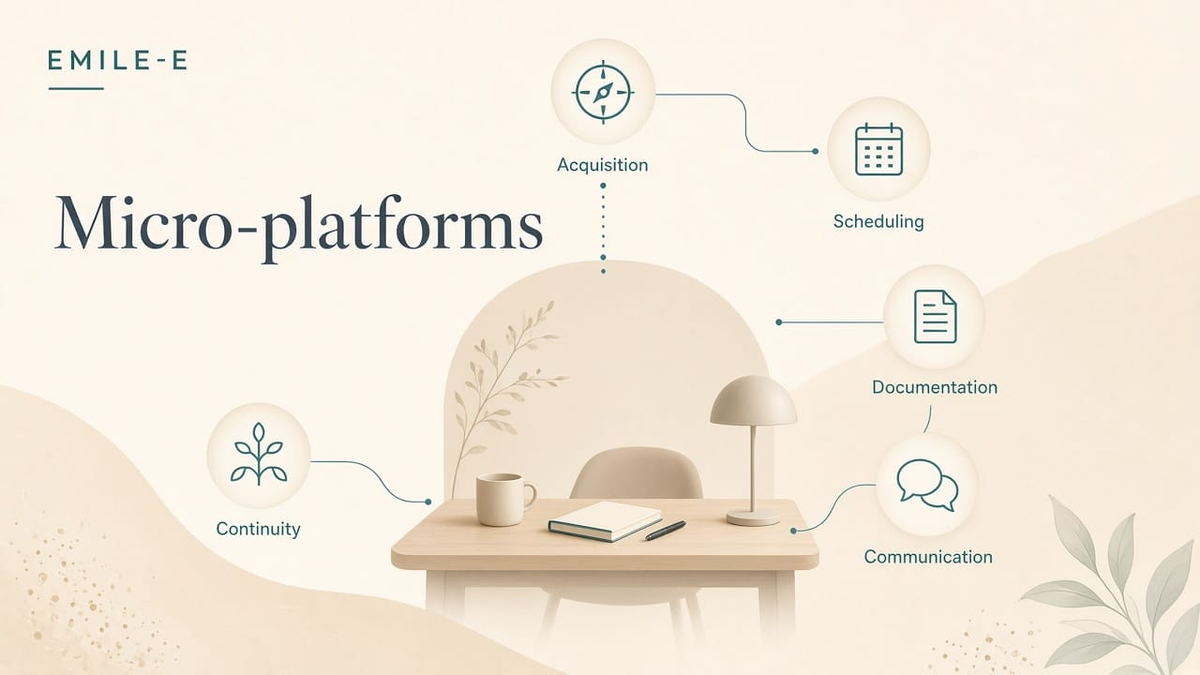
You still sit in the room. You still do the clinical work. But around that hour, a second practice appeared: websites, directories, booking links, note systems, secure messaging, reminders, claim portals, between-session touchpoints, and a quiet stack of passwords nobody else can decode when you are out.
That second practice is not optional anymore. It is how people find you, stay with you, and keep continuity when life does not respect a Tuesday at 3.
This week in The Unburdening we name what is already true: many solo and small practices have become micro-platforms. Not startups. Not brands chasing scale. Just clinicians who now orchestrate systems that used to require a back office.
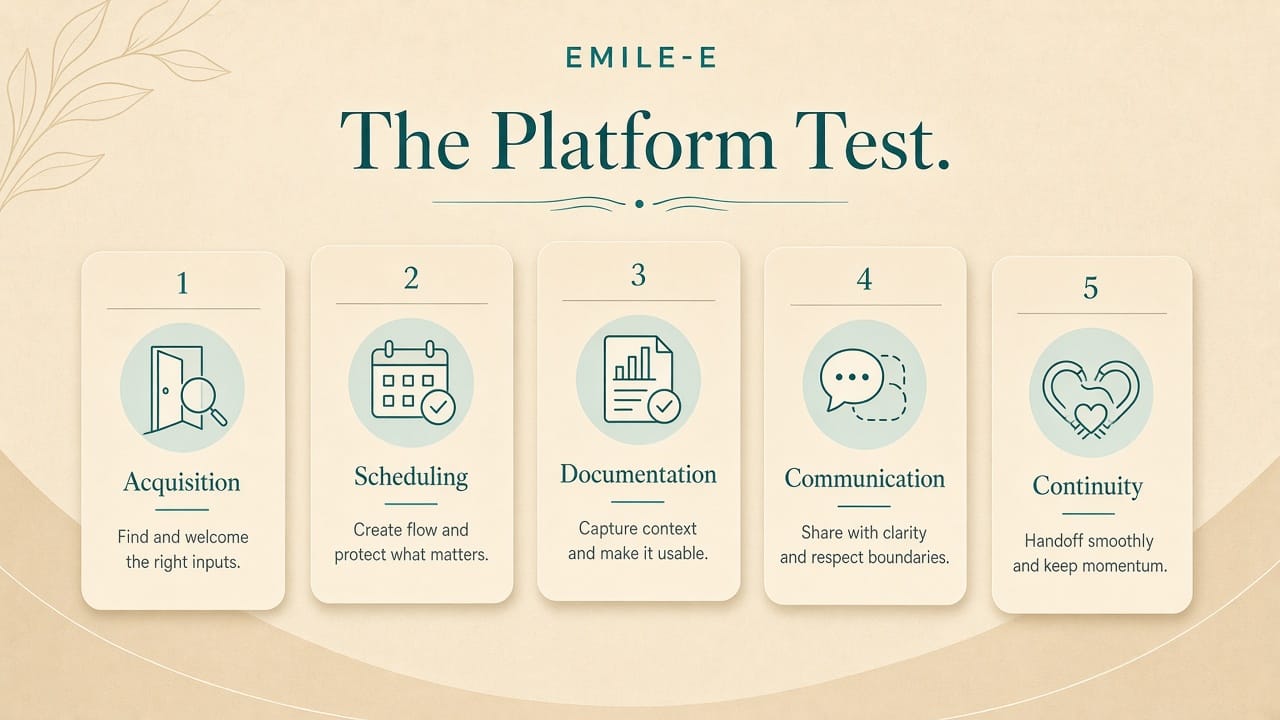
The Platform Test
A platform is not a logo. It is a set of jobs that have to stay answered together.
- Acquisition. How does a real person discover you without insider knowledge, and without drowning you in cold inquiries you cannot serve?
- Scheduling. Can someone book (or request) care without a phone tag maze, while you keep clinical boundaries intact?
- Documentation. Do notes, forms, and chart truth live somewhere durable, or scatter across inboxes and downloads?
- Communication. Is client and referrer contact bounded, auditable, and kind, or is it unpaid chat that burns the week?
- Continuity. What happens between sessions, after a no-show, or when the first door is not the right door?
If any one of those five is a brittle personal workaround, the practice is already a platform. It is just an informal one, held together by memory and overtime.
What used to be enterprise work
Larger organizations had departments for intake, billing, IT, and outreach. Independent clinicians inherited the outcomes of those departments without the headcount.
So the market filled the gap with tools. Some help. Some add another login and another half-truth about "efficiency." The clinician becomes the integration layer: the person who remembers which system has the real opening, which form was signed, and which message still needs a reply.
That is the quiet shift. The solo practitioner now manages a technology stack previously available only to larger organizations. The clinical hour did not get simpler. The surrounding hour got productized.
Sprawl is not strategy
More tools can look like progress. Often they are fragmentation with a receipt.
A micro-platform that works is not the longest tool list. It is a short stack that keeps the five Platform Test jobs coherent:
- One place that knows openings and caseload truth
- One place that owns chart and form state
- Clear rules for how people reach you between sessions
- A warm path when you cannot take someone
- Enough automation that the clinician is not the middleware
When those jobs live in five products that do not talk, you do not have a platform. You have a scavenger hunt with PHI risk and after-hours labor attached.
Presence is still the product
None of this is an argument for becoming a tech company. It is an argument for refusing to let the stack steal the room.
The Presence Test still wins: does this reduce cognitive load at the moment of care, or add another field, tab, or portal? Who does this serve when clinical time and admin time conflict? Could a person in crisis use the front door without heroic decoding?
The Platform Test sits beside Presence. Presence asks whether the hour stays human. Platform asks whether the systems around the hour hold without burning the human who runs them.
Winners will not be the biggest practices. They will be the practices that orchestrate systems without sacrificing presence.
What to audit this week
Pick your actual stack (not the aspirational one) and score each Platform Test job: solid, workable, or brittle.
Acquisition: Is discovery honest about fit, wait, and affordability?
Scheduling: Does booking protect boundaries, or train people to expect instant access you cannot sustain?
Documentation: If your laptop failed tonight, could another trusted clinician reconstruct what matters?
Communication: Is between-session contact defined, or negotiated by guilt?
Continuity: When someone falls through, who owns the next step?
Wherever the answer is "only in my head," that is the next design problem. Not a new feature chase. A clarity chase.
Coordination is the product
EMILE-E builds for the practice side of this micro-platform reality. Practice OS is meant to keep operational truth in one place so acquisition, scheduling, documentation, communication, and continuity stop living as five separate improvisations.
If a soft next step is useful: Practice OS is $89 per clinician per month. Optional white-glove data migration is $2,500. Self-serve migration is free. Soft packages: Lobby Ready adds VibedIn at $29 per month (after $125 hardware and shipping). Full Ecosystem adds VibedIn at $29 per month plus Sesh at $6 per clinician per month. A la carte Sesh alone stays $10 per clinician per month.
No invented urgency. No fake stack counts. Just the thesis: if you already run a platform, make it intentional.
Closing
You did not ask to become a micro-platform. The work asked it of you.
Acquisition. Scheduling. Documentation. Communication. Continuity.
Score the five. Strengthen the brittle ones. Protect the hour.
That is how a solo practice stays human while the stack gets real.
The Unburdening is EMILE-E's practice-side letter on building mental health infrastructure that holds. Quiet coordination over tool sprawl.